
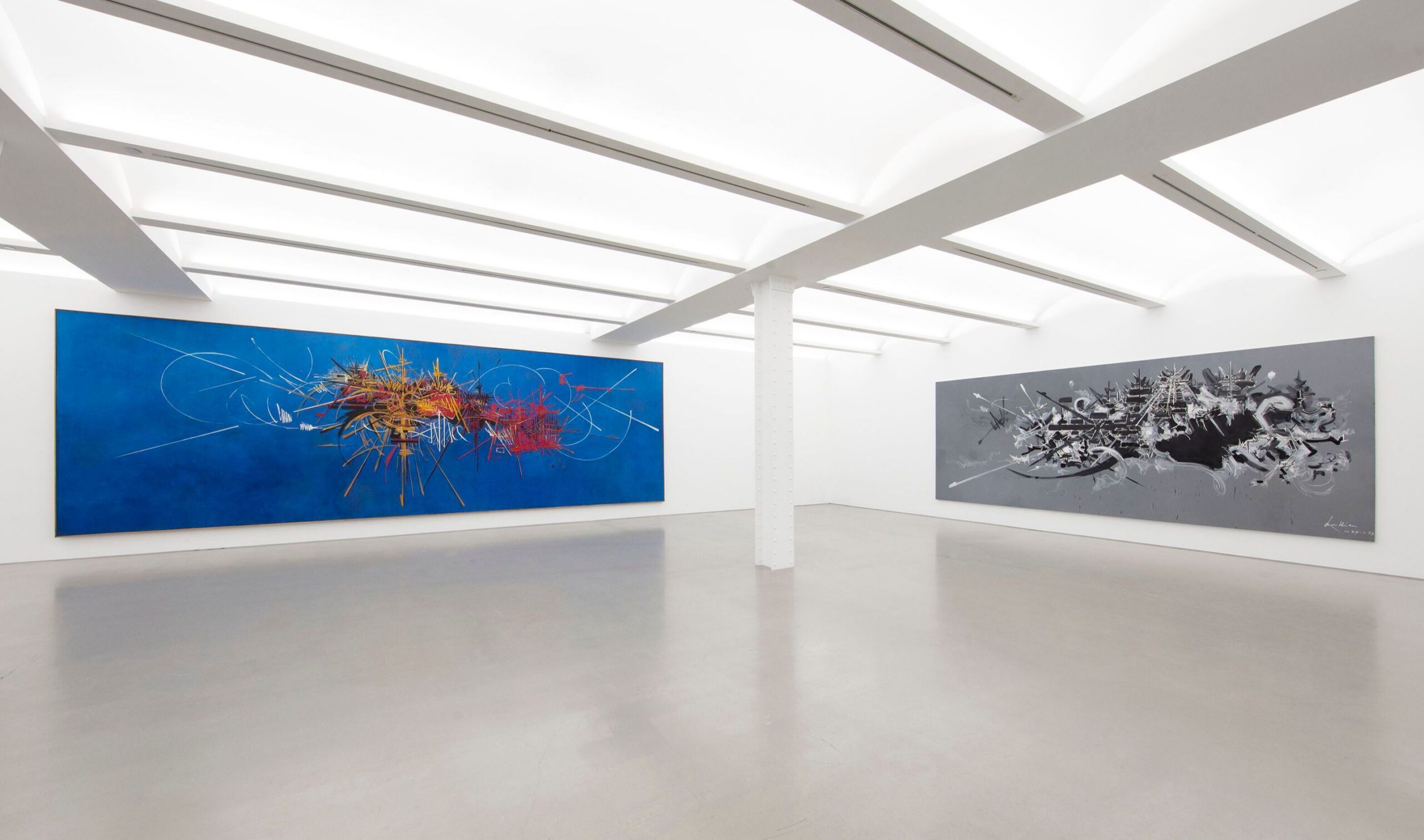
Marking the centenary of Georges Mathieu’s birth (1921–2012), the galleries Nahmad Contemporary and Perrotin, in collaboration with the artist’s estate, present the first extensive survey of his work in the United States, from 8 September to 23 October 2021. Spread across their two New York venues, the exhibition brings together more than fifty major paintings from every period, from the 1950s to the last canvases of the early 1990s.
The presentation gives particular prominence to large-format works by the artist shown in New York for the first time. It is the first major exhibition in the United States for the pioneer of Action Painting since the one at the Wildenstein gallery in New York in 1979.
Alongside works from the artist’s own collection, the exhibition gathers pieces lent by leading American institutions, among them the Albright-Knox Art Gallery in Buffalo, Michigan State University, the Museum of Fine Arts, Houston, the Phillips Collection in Washington, and the Wadsworth Atheneum in Hartford. It is accompanied by an extensive bilingual monograph, with a foreword by Édouard Lombard, director of the Georges Mathieu Committee, an essay by Germano Celant, the art historian who invented Arte Povera (the last he published before his passing), and an interview by Nancy Spector, former Guggenheim curator.
Georges Mathieu was one of the foremost French artists active during the 1950s and 60s. The centenary of his birth offers an ideal occasion to look back at the career of an artist and theorist who dedicated his life to an emotive, gestural, and highly nonrepresentational form of abstraction that had no correlative in the empirical world. The founder of Lyrical Abstraction, a movement that rejected the legacy of European geometric abstraction launched by Picasso’s Cubism and Mondrian’s De Stijl, Mathieu deeply influenced generations of artists working in the realm of performance and action-based painting.
— Nancy Spector
See the exhibition presentation by Perrotin and the review in Art in America.