
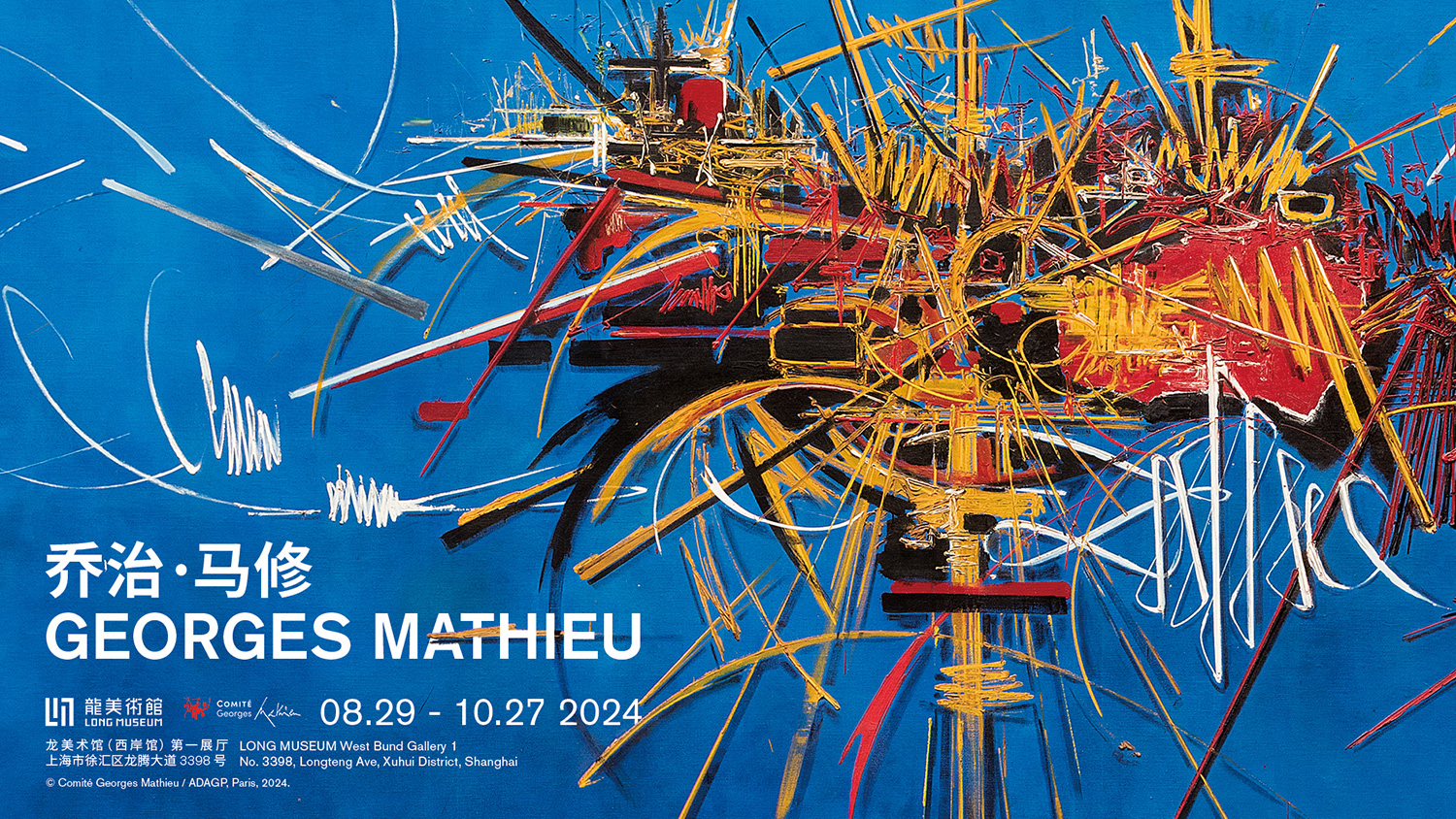
From 29 August to 27 October 2024, the Long Museum (West Bund) in Shanghai presents Georges Mathieu’s first retrospective in China. On a scale never before seen in Asia, it brings together works spanning more than four decades of creation.
This retrospective owed nothing to chance. Now that mainland China has been taking a close interest in post-war modern painting for some seven years, and today counts Zao Wou-Ki, who trained at the Hangzhou School of Fine Arts before settling in Paris in 1948 under the banner of Lyrical Abstraction, among its greatest painters, it was natural to trace the thread back to the movement’s founder.11Zao’s centennial retrospective closed in February 2024 in that very Hangzhou school. The two men knew each other: a famous photograph taken by Denise Colomb in 1953 at the Galerie Pierre shows them alongside Jean-Paul Riopelle, Jacques Germain, Maria Helena Vieira da Silva and the gallerist Pierre Loeb.
The exhibition unfolds in six sections, presented in these texts by Édouard Lombard: “Monumental Works”22Monumental works have a significant place in Georges Mathieu’s work from the 1950s through the 1980s. They speak to the artist’s ability to project his language over large surfaces, resulting from an explosive physical energy expressed as improvised choreography and an artistic urge that was intense, liberated, and open to transcendence. Just as importantly, they were often painted in public, which shows that in the early 1950s Mathieu had already anticipated “happenings” and performance art. He was influential in the development of these phenomena, which did not fully emerge until the following decade, and he inspired Gutai, Viennese Actionism, and Yves Klein, who in 1960 made his first public presentation of his Anthropométries in Mathieu’s presence., “‘Zen’ Artworks”33There is no “Zen” period of Georges Mathieu’s work, and the artist did not espouse it as a philosophy, stating that “Zen poses the problem of communication by refusing it.” However, he did repeat this term when it was used by others to describe some of his minimalistic works with few signs and a restricted palette, usually using black, red, and white. In the 1950s, Mathieu affirmed the importance of being able to “express the maximum with the minimum,” considering the artistic process complete as soon as any addition would become superfluous., “Anticipating Graffiti”44When a writer stated in 1956 that Mathieu “has come to take his surfaces as a challenge to his imagination, lucidly to betray them with his exuberant ‘graffiti,’” and another in 1958 mentioned “the graffiti [that] announce the prelude to a battle,” and a third in 1963 described “the orientalism that can be perceived in the drips of the brush and the graffiti,” this last word was used in its nineteenth-century sense, referring to inscriptions on ancient walls and monuments and by extension to the calligraphic nature of Mathieu’s works, rather than to street art, which did not yet exist. However, this calligraphic nature, the speed of the painting, the notion of risk, the production of artworks outside, and some elements such as splashes and blunt or inserted shapes, allow us to conclude that he anticipated some forms of urban art. Mathieu’s abstract writing directly inspired many European graffiti artists who acknowledged this, although it was conceived of in a cultural and philosophical world that was different from their own., “The Stylistic Experiments of 1960-1970”55In 1965, the large-scale exhibition organized by Galerie Charpentier inaugurated a sudden evolution in Mathieu’s pictorial language, reaffirming the elegance of his stylistic approach. He developed and codified new forms of non-representation as he experimented, describing “forms that are more serene, less aggressive, with more spirituality” and a “move from a cry to an aesthetic.” Color often played a leading role. Rigid structures now served as a foundation to the artist’s supple, lyrical signs. As he put it, “a new rigor appears at the same time as straight lines, right angles that are of value not in themselves, but as the support for the lines on top of them.”, “The Calligraphic Gesture”66The notion of calligraphy in Mathieu’s work was emphasized by André Malraux, who said, “Finally a Western calligrapher!” It was also theorized by Mathieu in his own writings. In the informal avant-garde movement within East Asian calligraphy in the early 1950s, he saw a discipline that paralleled his gestural language. He felt closer to this Asian art than to his Western colleagues due to the importance of working quickly: “The use of non-figurative signs is not sufficient to make this ‘writing’ calligraphy in the Asian sense. The only styles that coincide with my approach are Japanese kyo-so and Chinese tsao.” Mathieu laid out his analysis of what he called the “relationships of some aspects of lyrical non-figurative painting and Chinese calligraphy” during a dialogue organized in 1956 with Dr. Chou Ling, the Chinese permanent delegate to UNESCO., and “The Cosmic Turn and the Barbarian Period”77In the second half of the 1980s, with the cosmic turn and then the barbarian period, Mathieu left behind the aesthetic that was the basis for his style and embraced a freer intuition, thus returning to the foundations of the Lyrical Abstraction of the 1950s in a totally new form. The central composition disappears, allowing the shapes to extend and fill the canvas in a new kind of allover painting. The space of the composition is no longer closed and gains in depth. We see forceful gestures, erupting lines, explosions of paint and drips, and very contrasting colors.. Frescoes of four to nine metres, undertaken as early as 1952, made the journey, among them Paris, Capitale des Arts (1965), a nine-metre canvas that greets the visitor, La nécessité de l’espérance (1971), improvised before Frédéric Rossif’s cameras, and L’écartèlement de François Ravaillac, assassin du roi de France Henri IV, le 27 mai 1610, à Paris en place de Grève (1960). The route also leads from the Zen purity of Hommage à Louis IX (1957) to the contoured forms of Polybe and Zais (1970), which herald the aesthetics of graffiti, and on to the vehement gestures and shattered lines of the cosmic turn and then the barbarian period.
The exhibition is accompanied by a text by the art historian Antje Kramer-Mallordy.
See the exhibition on the Long Museum’s website.
Notes
- 1 Zao’s centennial retrospective closed in February 2024 in that very Hangzhou school. The two men knew each other: a famous photograph taken by Denise Colomb in 1953 at the Galerie Pierre shows them alongside Jean-Paul Riopelle, Jacques Germain, Maria Helena Vieira da Silva and the gallerist Pierre Loeb.
- 2 Monumental works have a significant place in Georges Mathieu’s work from the 1950s through the 1980s. They speak to the artist’s ability to project his language over large surfaces, resulting from an explosive physical energy expressed as improvised choreography and an artistic urge that was intense, liberated, and open to transcendence. Just as importantly, they were often painted in public, which shows that in the early 1950s Mathieu had already anticipated “happenings” and performance art. He was influential in the development of these phenomena, which did not fully emerge until the following decade, and he inspired Gutai, Viennese Actionism, and Yves Klein, who in 1960 made his first public presentation of his Anthropométries in Mathieu’s presence.
- 3 There is no “Zen” period of Georges Mathieu’s work, and the artist did not espouse it as a philosophy, stating that “Zen poses the problem of communication by refusing it.” However, he did repeat this term when it was used by others to describe some of his minimalistic works with few signs and a restricted palette, usually using black, red, and white. In the 1950s, Mathieu affirmed the importance of being able to “express the maximum with the minimum,” considering the artistic process complete as soon as any addition would become superfluous.
- 4 When a writer stated in 1956 that Mathieu “has come to take his surfaces as a challenge to his imagination, lucidly to betray them with his exuberant ‘graffiti,’” and another in 1958 mentioned “the graffiti [that] announce the prelude to a battle,” and a third in 1963 described “the orientalism that can be perceived in the drips of the brush and the graffiti,” this last word was used in its nineteenth-century sense, referring to inscriptions on ancient walls and monuments and by extension to the calligraphic nature of Mathieu’s works, rather than to street art, which did not yet exist. However, this calligraphic nature, the speed of the painting, the notion of risk, the production of artworks outside, and some elements such as splashes and blunt or inserted shapes, allow us to conclude that he anticipated some forms of urban art. Mathieu’s abstract writing directly inspired many European graffiti artists who acknowledged this, although it was conceived of in a cultural and philosophical world that was different from their own.
- 5 In 1965, the large-scale exhibition organized by Galerie Charpentier inaugurated a sudden evolution in Mathieu’s pictorial language, reaffirming the elegance of his stylistic approach. He developed and codified new forms of non-representation as he experimented, describing “forms that are more serene, less aggressive, with more spirituality” and a “move from a cry to an aesthetic.” Color often played a leading role. Rigid structures now served as a foundation to the artist’s supple, lyrical signs. As he put it, “a new rigor appears at the same time as straight lines, right angles that are of value not in themselves, but as the support for the lines on top of them.”
- 6 The notion of calligraphy in Mathieu’s work was emphasized by André Malraux, who said, “Finally a Western calligrapher!” It was also theorized by Mathieu in his own writings. In the informal avant-garde movement within East Asian calligraphy in the early 1950s, he saw a discipline that paralleled his gestural language. He felt closer to this Asian art than to his Western colleagues due to the importance of working quickly: “The use of non-figurative signs is not sufficient to make this ‘writing’ calligraphy in the Asian sense. The only styles that coincide with my approach are Japanese kyo-so and Chinese tsao.” Mathieu laid out his analysis of what he called the “relationships of some aspects of lyrical non-figurative painting and Chinese calligraphy” during a dialogue organized in 1956 with Dr. Chou Ling, the Chinese permanent delegate to UNESCO.
- 7 In the second half of the 1980s, with the cosmic turn and then the barbarian period, Mathieu left behind the aesthetic that was the basis for his style and embraced a freer intuition, thus returning to the foundations of the Lyrical Abstraction of the 1950s in a totally new form. The central composition disappears, allowing the shapes to extend and fill the canvas in a new kind of allover painting. The space of the composition is no longer closed and gains in depth. We see forceful gestures, erupting lines, explosions of paint and drips, and very contrasting colors.